

How Proximity to Transport Corridors Drives Industrial Property Value in NSW
If you own, manage or are looking to buy an industrial property in NSW, you’ve probably noticed that two sheds with almost identical floor space, clear height and land size can sell or lease for very different figures. Nine times out of ten, the gap comes down to one thing: how easily goods can get in and out of the property.
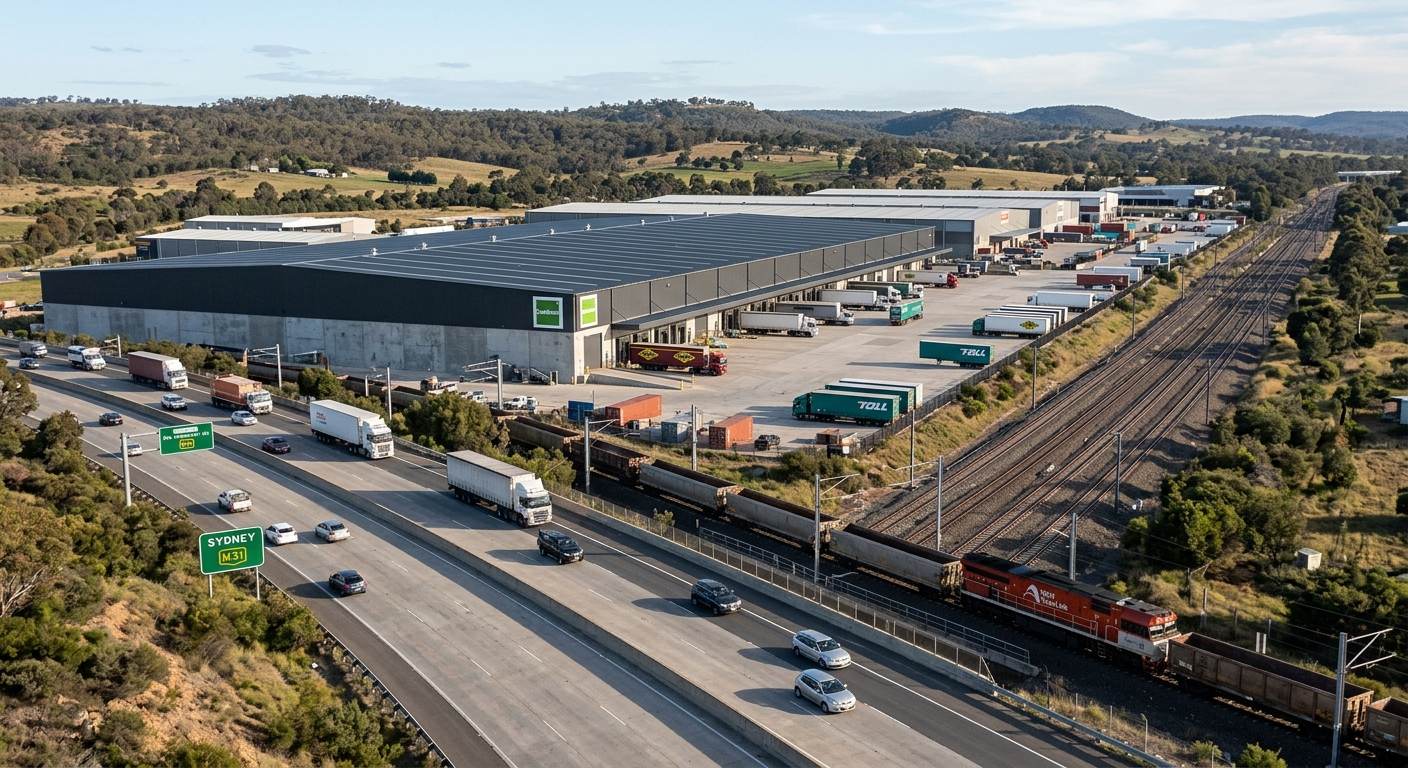
For industrial assets, location isn’t really about kerb appeal or nearby cafés. It’s about freight movement — how close the property sits to motorways, arterial roads, intermodal terminals, rail freight lines and ports, and how easily a B-double or container truck can actually get there without fighting congestion or council-imposed route restrictions. That’s why transport corridor proximity is one of the biggest single drivers behind an industrial property valuation, often outweighing factors that matter more in the residential or even office markets.
This article walks through why transport access matters so much for industrial value in NSW, how valuers actually factor it into a report, and what owners, buyers, investors and their advisers should be thinking about when transport infrastructure changes around a property.
Summary: What This Article Covers
In an industrial real estate valuation, freight accessibility can be an important consideration — including proximity to motorways, connections to ports and intermodal terminals, and, for some assets, heavy rail siding access. Sites within Sydney’s core industrial precincts near Port Botany, Moorebank and the growing Western Sydney Airport and Aerotropolis corridor are attracting strong occupier and investor demand because land suitable for logistics is limited and freight-efficient sites are scarce.
Key takeaways for readers:
- Transport access affects both rental income potential and the capitalisation rate a valuer applies, so it flows through to value from two directions at once.
- New motorways, upgraded arterial roads or rail infrastructure can lift or compress values in surrounding precincts well before construction is even finished, because the market prices in future accessibility.
- Not all “transport corridor” exposure is positive — properties on heavy through-routes can also face noise, road-widening acquisition risk or restricted access hours.
- Zoning, B-double route approval and council restrictions on truck movements matter just as much as physical distance to a motorway on-ramp.
- Because these factors shift quickly with infrastructure announcements, an independent valuation gives owners and buyers a more accurate, current picture than relying on older sales data or a real estate agent’s appraisal alone.
What Is Industrial Property Valuation, and Why Does Transport Access Matter So Much?
Industrial property valuation is the process of determining the market value of a warehouse, factory, distribution centre, cold store, or industrial land parcel, usually for a specific purpose — a purchase or sale, mortgage security, a family law settlement, a stamp duty assessment, insurance, or a rent review. A qualified valuer, typically a Certified Practising Valuer through the Australian Property Institute, prepares the report using recognised methods and current market evidence.
For most commercial and industrial assets, valuers lean heavily on the income capitalisation approach: they work out the net income a property produces (or could reasonably produce) and divide it by a capitalisation rate — essentially the yield the market currently expects for that type of asset in that location. They’ll also cross-check that figure against direct comparison, looking at recent sales of genuinely comparable properties, and sometimes a summation or cost approach for newer or purpose-built assets.
Transport access shows up in both halves of that equation:
- On the income side — a well-located site can command higher rent because tenants (particularly logistics and distribution operators) will pay a premium to cut freight time, fuel costs and driver hours. A distribution centre 10 minutes from a motorway interchange is worth more to a national retailer than an identical shed 40 minutes away down suburban streets.
- On the yield side — investors accept a lower capitalisation rate (which pushes value up) for assets they see as lower risk and more “future-proof.” Strong transport connectivity is one of the clearest signals of that resilience, because it supports long-term tenant demand even as the market cycles.
First Sign This Matters: Sydney’s Land Squeeze Around Freight Infrastructure
Sydney’s industrial market has been running tight for several years now, and the shortage is most acute in locations close to the CBD, Port Botany and established transport networks. Developers are finding it genuinely difficult to source appropriately zoned industrial land within the established employment corridors, and occupiers competing for a shrinking pool of well-connected sites are helping push both rents and capital values higher in those precincts.
This scarcity means transport-adjacent land in NSW often behaves differently from the broader property market. Even during periods where general commercial sentiment is cautious, well-located logistics land close to freight infrastructure can hold or grow in value because the fundamental driver — limited freight-efficient supply — doesn’t change quickly.
Sydney’s Core Freight Corridors and Precincts
A few precincts illustrate the point well:
- Port Botany and the Southern Enterprise precinct — proximity to Australia’s busiest container port keeps demand from freight forwarders, 3PLs and importers consistently strong, and land here remains some of the tightest and most valuable industrial real estate in the country.
- Moorebank — home to a major intermodal freight terminal linking road and rail freight movement, this precinct continues to draw strong occupier and investor interest from logistics operators wanting rail-linked distribution capability.
- Western Sydney (Kemps Creek, Erskine Park, Eastern Creek, Horsley Park) — long an industrial heartland thanks to M4, M7 and Great Western Highway access, and now benefiting from further arterial upgrades tied to the Western Sydney Airport and Aerotropolis development.
- Emerging Aerotropolis-linked corridors — with Western Sydney Airport now operating freight services, passenger services scheduled to commence on 25 October 2026, and the M12 Motorway open, the area’s freight and transport context has materially changed; any resulting property-value effect remains site-specific and should be supported by zoning, access and current market evidence.
If you’re valuing or considering a property in any of these areas, it’s worth understanding exactly which arterial roads, freight routes or rail links the site actually has approved access to — not just what’s nearby on a map.
How Valuers Actually Assess Transport Access (Not Just “Distance to Motorway”)
A common misconception is that transport access is measured simply as straight-line or driving distance to the nearest motorway on-ramp. In practice, a valuer will look at several layers:
1. Approved Heavy Vehicle Routes
A property might sit two minutes from a motorway by road distance, but if trucks have to travel through a residential street or a route not approved for B-doubles, that “closeness” is largely irrelevant for a logistics tenant. Valuers check the property against the relevant council or Transport for NSW B-double and higher mass limit route maps.
2. Access Hours and Local Restrictions
Some councils restrict truck movements during certain hours, particularly near residential interfaces. A site with 24-hour unrestricted access to the road network is generally worth more to a national logistics tenant than one with curfews, even if the two properties are geographically close together.
3. Intersection and Ramp Quality
Not all interchanges are equal. A signalised intersection that regularly banks up during peak periods effectively adds travel time even for a “nearby” property. Valuers and agents active in the area typically have a good feel for which interchanges genuinely function well for freight versus which look good on paper.
4. Rail Siding and Intermodal Access
For a smaller number of specialised industrial assets, direct rail siding access or proximity to an intermodal terminal like Moorebank can be a significant value driver, particularly for bulk or containerised freight users. This is a narrower market than road-based logistics, but it can command a real premium where it exists.
5. Future Infrastructure Timing
Because major road and rail projects take years to deliver, the market often starts pricing in improved access well before a road opens. This cuts both ways — values can run ahead of the actual improvement in accessibility, which is exactly why an independent, evidence-based valuation matters more than relying on listing prices or anecdotal “the market’s on fire” commentary during construction phases.
Transport Corridors Aren’t Always a Value Positive
It’s worth being upfront about the other side of this. Being near or on a major transport corridor doesn’t automatically mean higher value — sometimes it’s the opposite.
Road widening and compulsory acquisition risk. Properties fronting a road earmarked for future widening can carry acquisition uncertainty, which some buyers and financiers price cautiously. If your property sits along a corridor with a long-term road reservation or upgrade planned by Transport for NSW, it’s worth understanding exactly what’s proposed and how it might affect your title and building envelope, not just assuming proximity equals upside.
Noise, vibration and amenity impacts. A site directly adjacent to a heavy freight rail line or a major arterial can face genuine amenity issues — noise attenuation requirements, restrictions on certain uses, or reduced appeal to some tenant types.
Congestion working against you. A property near a corridor that’s chronically congested at peak times might get less benefit than the map suggests, particularly if freight movements are time-sensitive.
A good valuer will weigh these factors against the upside rather than assuming “near a motorway” is automatically a premium.
A Practical Scenario
Take two comparable 5,000 square metre warehouses in Sydney’s west, both built around the same time with similar clear height and office fit-out.
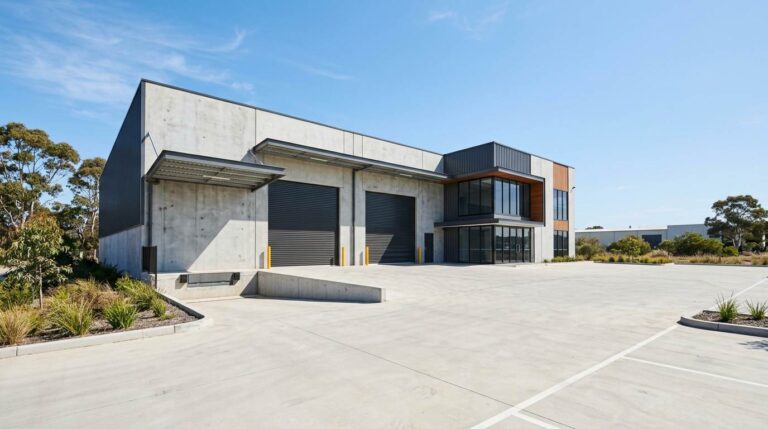
Property A sits within an established, well-signed industrial estate with direct, unrestricted B-double access onto a motorway less than five minutes away, and it’s zoned consistently with its current logistics use.
Property B is a similar size and quality but access runs through a narrower estate road with a council-imposed curfew on truck movements before 6am and after 10pm, and the nearest motorway on-ramp is 20 minutes away via a route that regularly congests during school and commuter peaks.
Even with identical building specifications, a valuer is likely to apply a firmer (lower) capitalisation rate and a higher achievable rent to Property A, reflecting stronger tenant demand and lower vacancy risk. The gap between the two properties in a formal valuation report can be substantial — sometimes well beyond what either owner would expect based on build cost or land size alone.
What This Means If You’re Buying, Selling or Refinancing
If you’re weighing up an industrial purchase, don’t rely solely on a real estate agent’s appraisal or an online estimate — these tools generally can’t account for the nuance of approved freight routes, access restrictions or upcoming infrastructure changes in the way a formal valuation can.
If you already own an industrial property near a growth corridor, an industrial valuation for warehouses and factories may be useful before refinancing, entering a rent review, or making a decision around a sale — particularly if nearby infrastructure has changed since your last valuation. Values in transport-affected precincts can move meaningfully within a relatively short period, and lenders, courts and the ATO will generally expect a valuation that reflects current market conditions rather than an outdated figure.
Frequently Asked Questions
Does being close to a motorway always increase industrial property value in NSW?
Generally yes, but it depends on approved access, congestion at the relevant interchange, and whether the route is suitable for the vehicle types your tenant needs to use. Straight-line distance alone isn’t a reliable guide.
How much does transport access affect an industrial valuation compared to building quality?
It varies by property, but for logistics-focused assets, location and access can outweigh building specification, particularly where floor space and clear height are already broadly comparable to the surrounding market.
Will the new Western Sydney Airport and Aerotropolis increase industrial land values nearby?
The surrounding precincts have already seen strong occupier and investor interest as infrastructure like the M12 Motorway has progressed. Whether that translates into sustained value growth for a specific property depends on its zoning, exact access and how the surrounding release areas develop over time — a current valuation is the most reliable way to understand where a particular site sits today.
Can road widening or a future motorway reservation reduce my property’s value?
It can, particularly if there’s uncertainty about compulsory acquisition or restrictions on future development. A valuer will factor in any known road reservations or planning overlays affecting the site.
Do I need a different valuation approach for industrial land versus a built warehouse?
Vacant or underutilised industrial land is often valued primarily on direct comparison to recent land sales, sometimes supplemented by a residual or highest-and-best-use analysis, while an improved property with a tenant typically leans more heavily on income capitalisation.
How often should an industrial property owner get a valuation updated?
There’s no fixed rule, but many owners review this around finance refinancing cycles, lease renewals, or whenever there’s a material change nearby — such as a new motorway opening, a rezoning, or a significant new tenant moving into the precinct.
Conclusion
Transport access is one of the strongest drivers of industrial property value in NSW, shaping both achievable rent and the yield investors are willing to accept. But proximity alone doesn’t guarantee a premium — approved access, congestion and acquisition risk all matter too. If infrastructure near your property has changed, or you’re making a decision that depends on an accurate figure, a current, independent valuation gives you a clearer picture than assumptions based on location alone.
If you’d like an independent, evidence-based industrial property valuation in NSW, Valuers NSW can help you understand how transport access and current market conditions apply to your specific property. You can reach the team on +61 438 080 786.